Project Management Icon Set 1: A Strategic Tool for Visual Clarity and Professional Impact
In the fast-paced world of project management, visual communication plays a critical role in conveying complex ideas clearly and efficiently. The Project Management Icon Set 1 offers a collection of meticulously designed glyphs that can enhance your workflow, improve team collaboration, and elevate the quality of your design projects. Whether you're developing a website, creating promotional materials, or designing an infographic, these icons provide a professional and consistent visual language that supports strategic decision-making and effective communication.
What Is Project Management Icon Set 1?
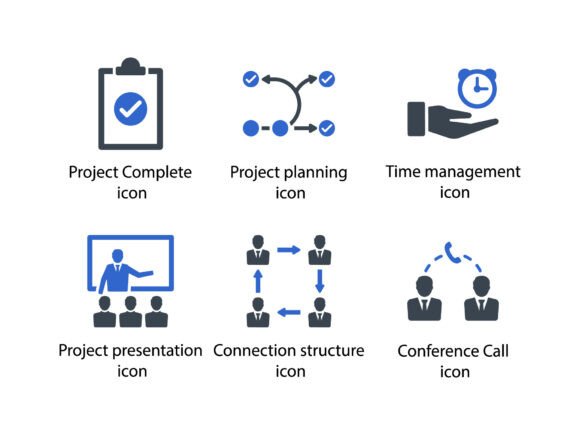
The Project Management Icon Set 1 is a comprehensive set of vector graphics representing key elements of project management processes. Each icon is crafted with precision, ensuring clarity and adaptability across various design platforms. The set includes essential symbols such as project schedules, success processes, meeting times, problem identification, hierarchy structures, and team collaboration. These icons are available in multiple formats—EPS, SVG, and PNG—making them versatile for use in digital and print media.
Unlike generic icons that may lack specificity, this set is designed with a focus on practicality and relevance. Each glyph reflects a real-world project management scenario, making it easier for teams to visualize and understand key concepts without relying solely on text.
Strategic Value of Project Management Icon Set 1
Integrating the Project Management Icon Set 1 into your design work can offer several strategic advantages. First, it enhances the visual storytelling of your project management processes. By using consistent and meaningful icons, you can communicate complex workflows more effectively, reducing ambiguity and improving stakeholder alignment.
Second, these icons support better planning and execution. When used in project timelines, Gantt charts, or process diagrams, they help break down tasks into digestible components. This visual breakdown can lead to more accurate estimations, improved resource allocation, and increased accountability among team members.
Third, the Project Management Icon Set 1 reinforces brand identity. Consistent use of well-designed icons across marketing materials, presentations, and internal documentation creates a cohesive visual experience that strengthens your brand’s professionalism and reliability.
When to Use Project Management Icon Set 1
The Project Management Icon Set 1 is most effective when used intentionally and in context. Consider incorporating these icons whenever you need to represent project management concepts visually. For example:
- Website Design: Use icons to illustrate project management tools, services, or features on your site.
- Promotional Materials: Enhance brochures, flyers, or social media posts with icons that highlight your project management expertise.
- Presentations: Simplify complex ideas by using icons to represent stages of a project, team roles, or key milestones.
- Infographics: Visualize data related to project performance, team productivity, or client satisfaction using relevant icons.
- Internal Documentation: Improve clarity in project plans, status reports, or training materials by including icons that align with your team's workflow.
By aligning the use of icons with specific goals, you ensure that each graphic serves a purpose and contributes to the overall effectiveness of your communication.
How to Approach Using Project Management Icon Set 1
Before integrating the Project Management Icon Set 1 into your work, consider the following steps:
- Define Your Purpose: Determine what you want to achieve with the icons. Are you simplifying a process, improving team communication, or enhancing your brand’s visual identity? Clarifying your objective ensures that the icons serve a meaningful role.
- Understand Your Audience: Tailor the use of icons to the needs and expectations of your audience. For instance, a client-facing presentation may benefit from more intuitive and recognizable icons, while an internal report might require more detailed and precise visuals.
- Ensure Consistency: Maintain a uniform style throughout your design projects. This includes color schemes, icon sizes, and placement. Consistency helps reinforce brand recognition and improves user experience.
- Test and Refine: Experiment with different placements and combinations of icons. Gather feedback from stakeholders or users to identify what works best and make adjustments accordingly.
By taking a thoughtful approach, you can maximize the impact of the Project Management Icon Set 1 and avoid common pitfalls like overuse or misinterpretation.
Considerations Before Relying on Project Management Icon Set 1
While the Project Management Icon Set 1 is a powerful tool, it’s important to recognize its limitations. Icons alone cannot replace clear communication or thorough planning. They should be used as a supplement to, not a substitute for, well-structured information and strategic thinking.
Additionally, not all icons will resonate equally with every audience. Some may find certain symbols confusing or culturally insensitive. Always test your designs with a diverse group of users to ensure that the icons are understood as intended.
Finally, consider the context in which the icons will be used. An icon that works well in a digital interface may not translate effectively to a printed material. Ensure that the chosen format (EPS, SVG, or PNG) meets the requirements of your project and maintains visual quality at different scales.
Practical Examples of Project Management Icon Set 1 in Action
Here are a few real-world scenarios where the Project Management Icon Set 1 can be strategically applied:
- Team Collaboration: Use the team collaboration icon in a project dashboard to indicate active participation and communication within the team.
- Problem Finding: Incorporate the problem-finding icon in a risk assessment document to visually represent areas of potential challenges or bottlenecks.
- Project Schedule: Display the project schedule icon in a timeline to show key milestones and deadlines, helping stakeholders track progress easily.
- Success Process: Highlight the success process icon in a case study or client testimonial to emphasize the outcomes achieved through effective project management.
- Meeting Time: Include the meeting time icon in a calendar or agenda to signal scheduled discussions and encourage preparation.
These examples demonstrate how the Project Management Icon Set 1 can be used to add clarity, structure, and visual appeal to a wide range of design and communication efforts.
Risks of Using Project Management Icon Set 1 Without Clear Goals
Without a clear understanding of your objectives, the Project Management Icon Set 1 can become a source of confusion rather than a tool for clarity. Randomly placing icons without a defined purpose may lead to:
- Overload: Too many icons can overwhelm the viewer and dilute the message you’re trying to convey.
- Misinterpretation: If icons are not aligned with the content, they may be misunderstood or ignored entirely.
- Inconsistency: Inconsistent use of icons can create a disjointed visual experience that undermines your brand’s professionalism.
- Wasted Resources: Investing time and effort into designing with icons that don’t serve a strategic purpose is inefficient and unproductive.
To avoid these risks, always tie the use of icons to specific goals and ensure they contribute to the overall message or outcome of your project.
Intentional Use of Project Management Icon Set 1
The key to leveraging the Project Management Icon Set 1 effectively is intentionality. Ask yourself: What do I want this icon to represent? How will it help my audience understand or engage with the content? And how does it align with my broader goals?
By answering these questions, you can ensure that each icon adds value and supports your strategic vision. Whether you’re communicating with clients, managing a team, or presenting to stakeholders, the right icons can make a significant difference in how your message is received and acted upon.